Mission Critical Services in PPDR Scenarios

On-demand 5G Non-Public Network with UAV-mounted base stations and a cloud-native MCX platform for first-responder coordination in disaster scenarios.

University of Aveiro, DETI Instituto de Telecomunicações Altice Labs

01Context and Motivation

When disasters destroy cellular infrastructure, voice and data services become unavailable precisely when they are most needed. This project deploys a Standalone 5G NPN on UAVs with VoNR and roaming (Local Breakout), paired with a dedicated MCX platform for mission-critical group communications, video, and location sharing among first responders.

02Architecture

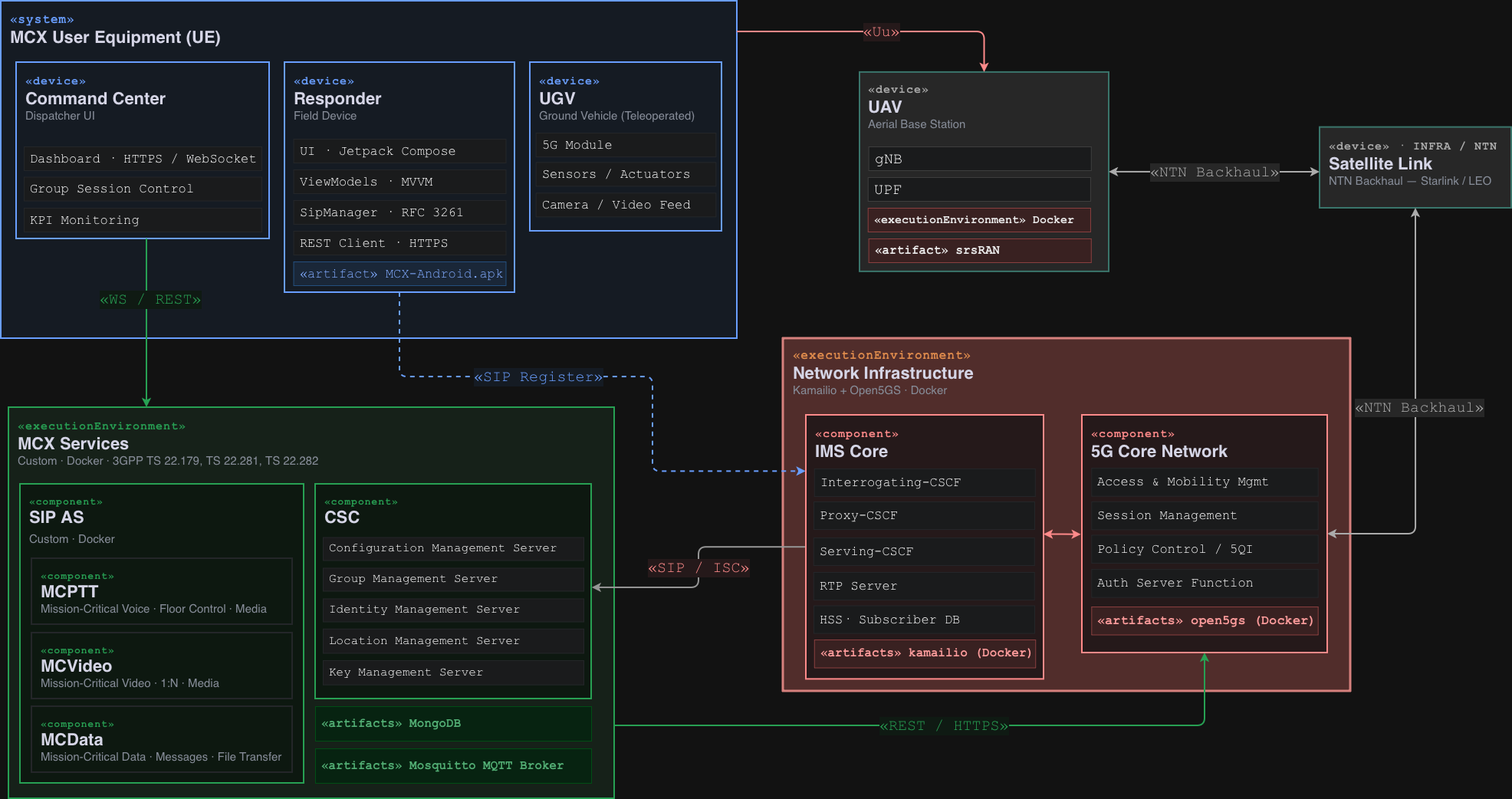
This architecture illustrates a mission-critical communications ecosystem designed for emergency scenarios where traditional infrastructure is unavailable. The system adopts a cloud-native and distributed approach, interconnecting field responders, aerial stations, and satellite networks.

1. The Operations Frontline (MCX User Equipment)

On the ground, the response is coordinated through three complementary components:

  • Command Center: The dispatch center providing dashboards, group session control, and KPI monitoring, communicating via WebSocket and REST.
  • Responder: The field operator's mobile device. Powered by an Android application (Jetpack Compose and MVVM architecture), it manages SIP registration and interacts with MCX services.
  • UGV (Unmanned Ground Vehicle): A teleoperated vehicle equipped with a 5G module for real-time video and sensor data transmission.

2. Tactical Connectivity & Backhaul (Radio Access and NTN)

To overcome the lack of terrestrial coverage, the architecture uses an aerial base station mounted on a UAV. This acts as an edge gNB and UPF, providing the 5G radio interface (Uu) to field equipment. Traffic is backhauled via a non-terrestrial satellite link (NTN), using LEO constellations such as Starlink.

3. The Network Core (Network Infrastructure)

The core system is a virtualized Docker-based infrastructure composed of two main blocks:

  • 5G Core Network: Based on Open5GS, providing mobility management, session handling, and policy control.
  • IMS Core: Powered by Kamailio, providing CSCF functions, RTP servers, and subscriber databases (HSS) for SIP routing.

4. The Critical Services Layer (MCX Services)

MCX services are orchestrated at the application layer. The SIP AS handles Push-to-Talk (MCPTT), video streaming (MCVideo), and data sharing (MCData). The CSC (Common Services Core) manages configurations, location, identity, and cryptographic keys. This layer is supported by MongoDB and MQTT brokers (Mosquitto).

In summary: The system is an end-to-end, autonomous and redundant architecture. From the field operator interface to the core services and satellite infrastructure, it ensures control, situational awareness, and real-time communication in critical scenarios.

03Video Demo & Features

FEATURE DETAIL

Press play on the demo. As the video walks through each feature, this panel reveals the technical details — services, signalling, KPIs.

MCData 1

Location Sharing

Continuous position reporting to enhance dispatcher situational awareness.

Responders publish periodic position updates via the Mosquitto MQTT broker. The CSC's Location Management Server distributes them to the Dispatcher Web over WebSocket and archives history in MongoDB.

MCX

Group Management

Dynamic creation, merging, and location-based group assignment.

Pre-arranged and on-demand groups are managed by the CSC's Group Management Server. Dispatchers create, merge, and split groups in real time, with assignment driven by responder roles and live location.

MCVideo

Video Streaming

Real-time video between field units and command post with adaptive bitrate.

MCVideo streams travel over SIP-negotiated RTP sessions through rtpengine. Field units stream live from Android, the UAV-mounted gNodeB carries the radio, and the Dispatcher Web renders feeds in resizable video tiles.

MCPTT

Push-to-Talk

Half-duplex group voice with floor control arbitration.

Voice sessions are anchored by the SIP AS acting as a B2BUA. Floor control follows 3GPP TS 24.380, granting the talker by priority, while rtpengine relays media across all group participants.

MCData 2

Messages

Real-time group and private messaging with secure, reliable, low-latency delivery.

Group messages are fanned out by the SIP AS, which replicates each SIP MESSAGE to every group member. One-to-one messages take a different path through the SMSC (Short Message Service Centre), with the CSC handling identity and key provisioning behind both flows.

Integration

UGV Teleoperation

Remote operation of unmanned ground vehicles (UGVs) through Android application.

The UGV joins the same MCX layer: live video flows over MCVideo, while teleoperation commands ride MCData on the 5G uplink up to the UAV. Latency stays inside the 3GPP TS 22.179 mouth-to-ear envelope validated in the KPI tests.

04Responder App UI

The field operator's tactile interface, built in native Android (Jetpack Compose). Explore the different app modules interactively.

22:48
BOMBEIROS AVEIRO
Bombeiro1 Bombeiro1
Bombeiro2 Bombeiro2
Bombeiros Aveiro 22:45
Team B confirmed. North sector clear.

Bombeiro1 21:30
Ok. Advance to coordinate B7.
Bombeiro2 20:15
Arriving in 5 minutes. No obstacles on route.
Bombeiros Aveiro Online
Message...
Bombeiro2
PTT CHANNEL
PTT Channel
IDENTIFICATION
IMSI / PHONE 001010000086816
NETWORK
MOBILE IP 192.168.7.26
SIP SERVER 10.0.22.112
SESSION STATUS
SIP REGISTRATION SUCCESS
PTT GROUP Waiting...

05Dispatcher Web UI

A fictional command-post dashboard inspired by dispatcher-web. Switch views, focus responders, inspect groups, and open live video tiles.

DISPATCH//CMD
--/--/---- --:--:--
Bombeiro1
001010000086815
live
Changes saved locally

06Team

Supervisors

Duarte Raposo
Instituto de Telecomunicações
Filipe C. Pinto
Altice Labs
Joaquim Ramos
Instituto de Telecomunicações
José Oliveira
Instituto de Telecomunicações
Pedro Rito
Instituto de Telecomunicações
Pedro Valente
Instituto de Telecomunicações
Susana Sargento
Instituto de Telecomunicações

Students

André Vasconcelos
118827
Dylan Scrivens
118512
José Penacho
121357
Rhyan Jackson
120495
Tiago Fernandes
120271
Tiago Mendes
119378

07Repository & Documentation